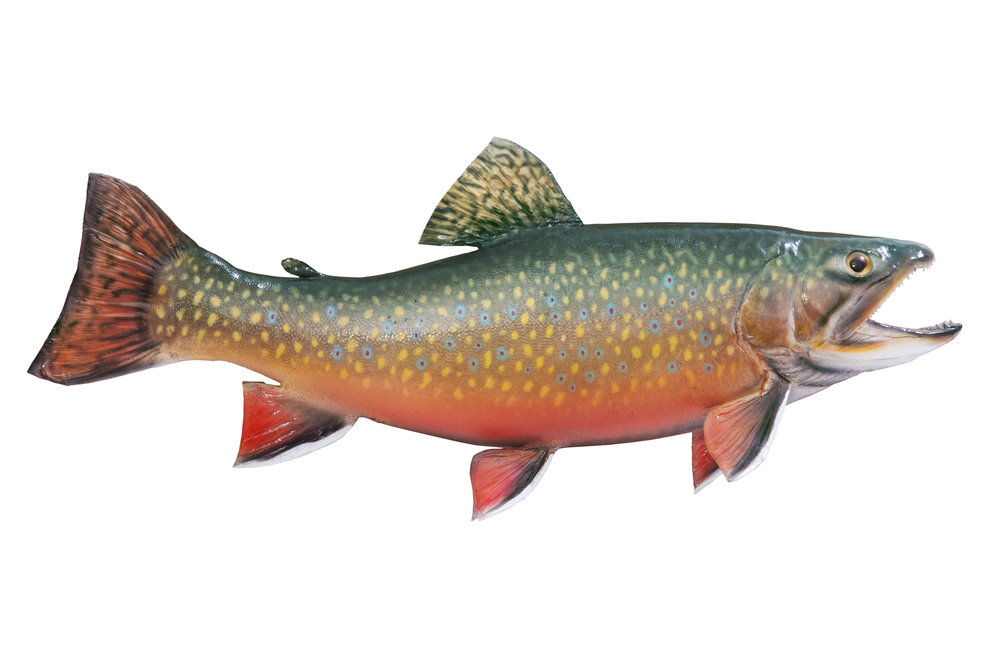
Markings and Coloration The brook trout can be recognized by the wavy lines, or vermiculations, on its dark, olive-green back–the same pattern created when the sun shines through rippled water to cast shadows on the bottom. The result is a camouflage enabling the brook trout to avoid predators from above such as kingfishers and herons. The brook trout also typically has many pale yellow spots and a few small red spots surrounded by blue halos on their sides. They’ve also been described as the only trout with light spots against a dark background, as the brown and rainbow trout have the opposite spotting pattern (dark spots on a paler background). The brook trout’s pectoral, ventral, and anal fins are starkly edged in white, which again is unique among other common trout. The white is the main giveaway. Even when the brook is motionless, the white-edged fins will call your attention to the fish. The highly visible, white-edged fins are a definite disadvantage when it comes to the brook’s predators. Another characteristic is a relatively large head and mouth, and the head may amount to one quarter of the body length on adult fish. During their fall spawning period, the lower flanks of males become brilliant orange and older males may develop a slightly hooked lower jaw. If you are still in doubt after checking all the previous characteristics, feel along the center of the mouth’s roof with your fingertip. The vomerine bone has teeth in a small cluster at its forward end. If you find teeth all along the roof of the mouth, you didn’t catch a “brookie”. Because...
Townsend, TN bills itself as “The Peaceful Side of the Smoky Mountains”. And true to its name, it does have a much slower and easier pace than its neighboring towns of Gatlinburg and Pigeon Forge TN. More important is its close proximity to Cades Cove. Townsend is the closest of the towns bordering the Great Smoky Mountains National Park and is the most visited part of the Park. In fact, Townsend’s Tuckaleechee Cove is rich in Appalachian history and heritage. Here the Little River gently descends from the Great Smoky Mountains National Park into this quiet community, and was a natural settlement area that has attracted and served as home to pioneers for hundreds of years. In fact, archaeological digs in the Townsend area have recently uncovered evidence of settlers dating back thousands of years. As early as the 1700’s, white settlers settled the areas of Townsend and nearby Cades Cove. Today, several museums and historic sites keep us connected with the past. In the early 1900’s, the Little River Railroad and Lumber Company ruled the area when they logged thousands of acres until 1928, when locals fostered the idea for creating a national park. The railroad museum that exists here today contains hundreds of photographs, well-restored railroad equipment and entertaining exhibits to interest the traveler. True railroad enthusiasts can enjoy viewing the preserved locomotives and logging equipment. For more info, contact the Townsend Little River Railroad and Lumber Company Museum at 865-448-3060. From Townsend, you are only 25 minutes to Dollywood and Pigeon Forge TN, Gatlinburg, and Sevierville. Start your visit at the Townsend Visitors Center. Call 865-448-6134...
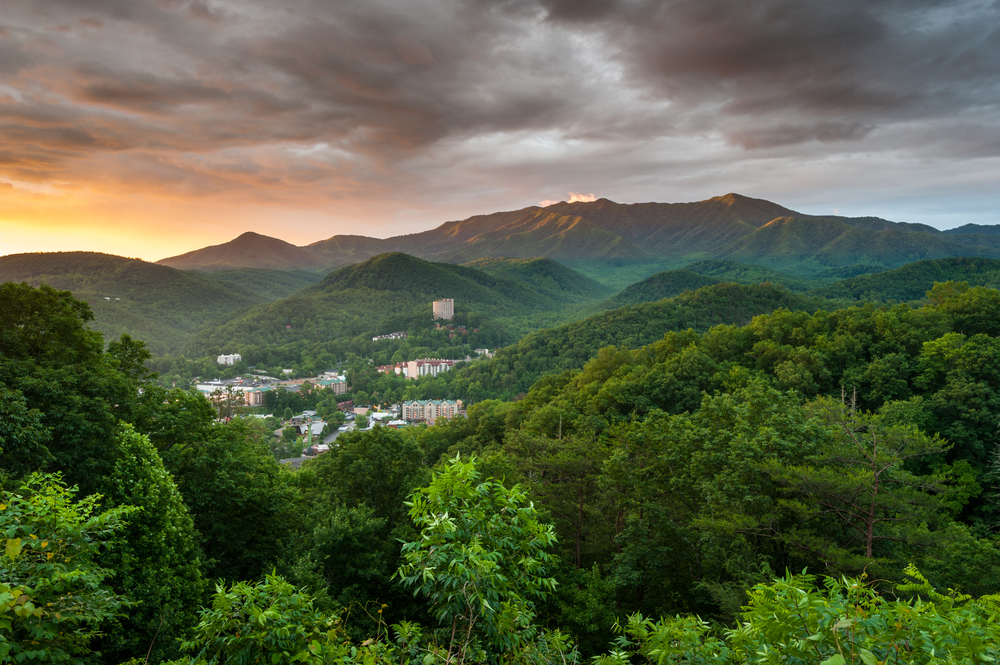
Viewing Mt LeConte by webcam is no comparison to the real sight of the Smokies, but it does help fill the void that the Smoky Mountains leave behind. Whether you’re wanting to check weather conditions or you just need a glimpse of the Great Smoky Mountains to start your day off right, take a look at a Mt LeConte webcam and see the unbelievable views of the Smokies. Here’s what you’ll find: Best Mt LeConte Webcam There are several organizations and individuals who have Mt LeConte cameras set up, and some are even on 24/7. We like the National Park Service’s Mt LeConte webcam the best! This webcam provides a great look at Mt LeConte, along with current information about the visual range of the view you’re seeing, as well as air quality. There are even tabs to help you identify landmarks and a map illustrating the range of the webcam. On a good visibility day, you can see 124 miles into the distance, giving you a stunning view of Mt LeConte on the horizon. On foggy days, the visibility is reduced to around 26 miles, but the view is still stunning! We’ve listed a couple sights you should definitely take note of below: 1. Stunning Sunsets and Sunrises Waking up with the sun is one thing, but being up and on the trail early enough to make it to a mountain summit high enough to observe Mt LeConte might be a little more difficult. Luckily, a Mt LeConte webcam enables you to take in breathtaking sunsets and sunrises with Mt LeConte in the distance without having to worry about achieving perfect timing. 2. Mt...
How well do you know Smoky Mountain history? Read our favorite historical facts below to test your knowledge. You never know, some of these may surprise you! 1. The Smoky Mountains Are Among the Oldest in the World It is estimated the mountains in the Great Smoky Mountains National Park are between 200 and 300 million years old. When you take into consideration the national park is only turning 100 in 2016, that is a lot of Smoky Mountain history we may never know about. The age of the mountains is determined by the amount of weathering the rocks have experienced. You can also partially tell the age by the particles found in the soil and the trees found on the mountains. 2. A Woman Was the First Settler to the Smoky Mountains One of the lesser known Smoky Mountain history facts is that the first settler to the area was a woman. Although William Ogle is credited for building the first home in the area, it was actually his wife, Martha Jane Huskey Ogle, who first moved here. William passed away before he could settle into the home with his wife and kids. 3. It Was the First National Park to be Partially Federally Funded As you know, entrance to the Great Smoky Mountains National Park is completely free for all visitors. The reason behind this is the fact that it was the first national park to ever be partially funded by the federal government. The stipulation came when Newfound Gap Road was built. Because it was the only way at the time to easily travel between the...
One of the most important things to consider when visiting and hiking Mt LeConte is the weather. Although the mountain is in a region that enjoys a mild climate with four distinct seasons, Mt LeConte weather conditions vary considerably depending on elevation and do not necessarily reflect the conditions of the city below due to the great difference in elevation. At 6,593 feet, Mt LeConte is the third highest peak in the Great Smoky Mountain National Park. When measured from its immediate base to its highest point, however, Mt LeConte is considered to be the tallest mountain in the entire Eastern United States, rising 5,301 feet from its base near Gatlinburg. While the mountain does experience seasonal weather changes, and there may be better times to plan a hike than others, Mt LeConte weather has a climate with cool summers and cold, snowy winters. The climate is significantly cooler and fairly wetter than Gatlinburg’s. The lowest temperature ever recorded was -32°F and the highest temperature recorded at Mt LeConte was 85°F. Month High Low Monthly Precipitation Monthly Snowfall Days of Precipitation Jan 35 19 7.0″ 18″ 12 Feb 35 18 8.2″ 20″ 12 March 39 24 8.2″ 26″ 12 April 49 34 6.5″ 5″ 10 May 57 43 6.0″ Trace Amounts 10 June 63 49 6.9″ 0 11 July 65 53 8.3″ 0 13 Aug 64 52 6.8″ 0 12 Sept 60 47 5.1″ Trace Amounts 8 Oct 53 38 5.4″ 2″ 8 Nov 42 28 6.4″ 5″ 9 Dec 37 21 7.3″ 8″ 10 Seasonal Mt LeConte Weather Spring – As with the surrounding area in lower elevations,...